Thursday, January 5, 2012


Sunday, October 30, 2011
नाट्यरंग : ‘पाहिजे जातीचे’ गुंतवणारं कथानाटय़!
Lokasatta Marathi news paper- रवींद्र पाथरे, रविवार, ३० ऑक्टोबर २०११

‘पाहिजे जातीचे’ गुंतवणारं कथानाटय़!
नाटककार विजय तेंडुलकरांची मिताक्षरी, परंतु संपृक्त लेखनशैली, त्यातून व्यक्त होणारा धारदार आशय, त्यांची विषयाला भिडण्याची थेट पद्धती आणि त्याकडे पाहण्याचा खास तेंडुलकरी दृष्टिकोन यामुळे त्यांची कुठलीही कलाकृती असो, मनुष्य त्यात कळत-नकळत गुंतत जातो. ‘पाहिजे जातीचे’ हे त्यांचं नाटककार म्हणून ऐन बहरात असतानाचं नाटक. नाटकापेक्षा कथानाटय़ाकडे अधिक झुकणारं. ‘कहानी का रंगमंच’ ही संकल्पना हिंदीभाषक नाटय़कर्मी देवेन्द्र राज अंकुर यांनी रुजविल्याचे डिंडिम ‘भारतीय रंगभूमी’वर वाजविले जात असले, तरी त्यांच्याही कितीतरी दशके आधीच ही संकल्पना मराठी रंगभूमीवर अस्तित्वात आलेली होती. मात्र, असल्या गोष्टींचं अनावश्यक भांडवल करण्याची मराठी रंगभूमीची पद्धत नसल्यानं त्याचं श्रेय असे कुणीही सोमेगोमे घेतात. आणि याला आपण आक्षेपही घेत नाही, हे आपलं दुर्दैव. असो. तेंडुलकरांनी कथानाटय़ाचा हा फॉर्म अत्यंत लीलया हाताळलेला दिसतो. ‘पाहिजे जातीचे!’ हे त्यापैकी एक नाटक. या नाटकाच्या बाबतीत आणखीन एक गोष्ट नमुद करायला हवी. ती ही की, तेंडुलकर कुठल्याही घटना-प्रसंगांकडे बुद्धिवादी, वस्तुनिष्ठ चष्म्यातूनच नेहमी पाहत आलेले असल्यानं त्यांच्या नाटकांतून (नव्हे, सर्वच कलाकृतींतून!) रोमॅंटिसिझम अभावानंच आढळतो. अपवाद फक्त : ‘अशी पाखरे येती’ आणि काही अंशी ‘पाहिजे जातीचे!’ त्यामुळे हे तेंडुलकरी नाटक असूनही हळुवारपणाचा एक नाजूक स्पर्श त्यात जाणवतो. नाटकाच्या नावावरून प्रथमदर्शनी त्यात जातिगंडाची समस्या मांडली असावी असा सकृतद्दर्शनी समज होत असला तरी जातिश्रेष्ठतेचा पुसटसा उल्लेख वगळता हे नाटक वेगळ्याच अंगानं एका तरुणाचं आयुष्य रेखाटतं. पालवी प्रॉडक्शननं ‘पाहिजे जातीचे!’ हे नाटक पुन्हा रंगभूमीवर सादर करून प्रेक्षकांना तेंडुलकरी नाटकाचा एक वेगळा वानवळा पेश केला आहे.
महिपती पोरपारणेकर या चिवित्र नावाचा तरुण घरच्या दैन्य-दारिद्रय़ाशी दोन हात करत महत्प्रयासानं तिसऱ्या वर्गात का होईना, एम. ए. व्हायचं आपलं स्वप्न अखेरीस पुरं करतो. त्यासाठी त्यानं भयंकर खस्ता खाल्लेल्या असतात. पदवी हाती पडताच आपलं आयुष्य बदलेल, अशी त्याची भाबडी समजूत असते. प्रत्यक्षात मात्र एम. ए.ची पदवी हातात पडताच त्याची प्रेसमधली तुटपुंज्या पगाराची नोकरीही जाते. पदवीधर महिपतीला कमी पगारात राबवून घेणं योग्य नसल्याचं कारण देऊन नोकरीतून कमी केलं जातं. त्यामुळे जिवाचा आटापिटा करून मिळविलेल्या पदवीबद्दल आनंद व्यक्त करायचा, की त्यापायी नोकरी गेली म्हणून शोक करायचा, हेच महिपतीला समजेनासं होतं. तो जिथं नोकरी करत असतो त्या नियतकालिकाचे ध्येयवादी संपादक ईश्वरभाई त्याची चक्क बोळवण करतात. हताश महिपती आता पुढं काय करायचं, या भुंग्यानं संत्रस्त होतो. तो मग महाराष्ट्रातील झाडून साऱ्या कॉलेजांतून प्राध्यापकपदासाठी अर्ज खरडण्याचा सिलसिला सुरू करतो. परंतु सगळ्यांकडून या ना त्या शब्दांत नकारच वाटय़ाला येतो. असंख्य नकारघंटांनंतर अखेरीस एका दूरच्या गावातल्या कॉलेजातून मुलाखतीसाठी त्याला पाचारण करण्यात येतं. पण तेवढय़ानंही महिपती प्रचंड खूश होतो. कमसे कम कॉल तरी आला! पण इंटरव्ह्यूला जायचं तर अंगावर बरे कपडे हवेत. त्यासाठी लॉण्ड्रीवाल्याला मस्का लावणं आलं! लॉण्ड्रीवाला महिपतीच्या आधीच्याच थकलेल्या बिलांबद्दल त्रागा करत शेवटी त्याला मुलाखतीला जाण्यासाठी भाडय़ानं कपडे देतो.

महिपती एसटीनं त्या गावात उतरतो खरा; पण तिथली सगळी माणसं त्याच्याकडे चमत्कारिक नजरेनं बघत राहतात. कुणीही त्याला कॉलेजचा पत्ता धडपणे सांगत नाही. शेवटी आपल्या आपणच कसंबसं शोधत तो कॉलेजात पोहचतो. पाहतो तर तो चक्क गुरांचा गोठा असतो. बाहेर कॉलेजची पाटी लावलेली असते. त्यावरून इथं आपल्यासमोर काय वाढून ठेवलंय, याची महिपतीला कल्पना येते. परंतु चालून आलेल्या एकमेव नोकरीला भिडण्याशिवाय आता त्याला गत्यंतरही नसतं.
गावातले पुढारी कम् शिक्षणसंस्थेचे गावठी चेअरमन त्याची खिल्ली उडवत त्याचा ‘इंटरवू’ घेतात आणि त्याला आपल्या कालिजात चिकटवून टाकतात. कॉलेजच्या प्राचार्याना तर ते घरगडय़ाप्रमाणेच वागवतात. इंटरव्ह्य़ूच्या या फार्सवरून इथं आपल्याला कशाकशाला तोंड द्यावं लागणार आहे, याचा अंदाज महिपतीला येतो. आणि पहिल्याच दिवशी वर्गावर गेल्यावर त्याचा झणझणीत अनुभवही येतो. गावातली इरसाल पोरं त्याची वर्गात शिरल्या शिरल्या जी फे-फे उडवतात, त्यानं तो पारच गळाठतो. परंतु आता अंगावर आल्यावर शिंगावर घेण्याशिवाय तरणोपाय नाही, हेही त्याला कळून चुकतं. तेव्हा मग बाह्य सरसावून पोरांचा नेता असलेला सरपंचाचा गावगुंड पोरगा बबन्या याला महिपती भर वर्गात अस्खलित गावरान शिवीगाळ करत चक्क कानफटवतो. घडल्या प्रकारानं सगळी पोरं बिथरतात. बबन्या तर सुडानं फणफणतो. मात्र महिपती ‘ज्या गावच्या बोरी, त्याच गावच्या बाभळी’ ही उक्ती अंगीकारत पोरांना त्यांच्यासारखंच वागून आपल्या बाजूनं वळवतो आणि त्यांचा विश्वास पैदा करतो. महिपतीच्या या वागण्यानं सूड घेण्यासाठी आसुसलेला बबन्याही शेवटी नांगी टाकत महिपतीच्या कळपात शिरतो.
कॉलेजातील महिपतीच्या सहकारी प्राध्यापकांना त्यानं गावातल्या वांड मुलांवर नेमकी काय जादू केली, हेच कळत नाही. महिपतीचं मुलांमधलं हे वाढतं वर्चस्व प्राचार्याना खुपू लागतं. ते चेअरमनच्या गावंढळ तरुण पुतणीला कॉलेजात लेक्चरर म्हणून चिकटवून घेतात. तेही महिपतीच्या हाताखाली! जेणेकरून यथावकाश त्याला नारळ देता यावा! महिपती त्यांची ही चाल ओळखतो आणि नलिनीलाच फितवायचं ठरवतो. बबन्याच्या ‘कर्तृत्वा’नं त्याला ही संधी आयतीच चालून येते आणि महिपतीचं नलिनीशी गुटर्गु सुरू होतं.
यथाकाल अशा गोष्टींचा बोभाटा व्हायचा तो होतोच. चेअरमनच्या कानावर या गोष्टी जातात. ते महिपतीच्या मागे असा काही झक्कू लावून देतात, की त्याला नलिनीशी साधं बोलणंही मुश्कील होतं.
..महिपती या त्रांगडय़ातून कसा काय मार्ग काढतो, त्यात तो यशस्वी होतो का, वगैरे गोष्टी प्रत्यक्ष नाटकात पाहणंच योग्य!
म्हटली तर ही कथा आहे- एका लहानग्या गावातून मोठं स्वप्न उराशी बाळगून प्रतिकूल परिस्थितीशी दोन हात करणाऱ्या एका तरुणाची! म्हटलं तर माणसाच्या उपजत शहाणपणानं प्राप्त परिस्थितीवर कशी मात करता येते, याचं दर्शन घडवणारं हे नाटक आहे. या नाटकात तेंडुलकरांच्या सूक्ष्म नर्मविनोदाचा, तसंच माणसांच्या चित्रविचित्र नमुन्यांच्या सखोल निरीक्षणाचा जागोजागी प्रत्यय येतो. घटिताला नाटय़पूर्ण कलाटणी देण्याचा त्यांचा गुणही यात जाणवतो. अनेक नाटय़स्थळं, असंख्य पात्रं, काळाचा मोठा पट, नाटय़मय घटना-घडामोडी असं सगळं भलंथोरलं प्रकरण या नाटकात अभिप्रेत असल्यानं ते सादर करताना प्रायोगिकतेचा आधार घेण्याशिवाय पर्यायच नाही. दिग्दर्शक अनिल गवस यांनी तो कौशल्यानं घेतलेला आहे. एकातून एक प्रसंग उलगडण्यासाठी त्यांनी सूचक नेपथ्याचा केलेला वापर याचंच द्योतक आहे. यातले प्रसंगबदल प्रेक्षकांच्या साक्षीनंच होतात. प्रदीप पाटील यांच्या स्थळसूचक फ्लॅट्सनी व मोजक्या प्रॉपर्टीनं हा पट उलगडण्यास मोलाचं साहाय्य केलं आहे. अनिल गवस यांनी हा स्पॅन प्रकाशयोजनेद्वारे ठळक केला आहे. दिग्दर्शक म्हणून ठसठशीत आणि सुस्पष्ट पात्ररेखाटनावर गवस यांनी जोर दिलेला आहे. त्याचवेळी नाटय़ांतर्गत गती कायम ठेवण्यावर त्यांचा भर जाणवतो. यातली दोन गाणी मात्र नाटकाच्या ओघवत्या प्रवाहात अवरोध बनून येतात. ती टाळता आली असती तर बरं झालं असतं. गवस यांनी नाटकाची जातकुळी ओळखून त्यानुरूप त्याची हाताळणी केली आहे. मात्र, दुसऱ्या अंकात आत्याबाईर्ंच्या अपहरणाचा प्रसंग थोडा अनावश्यकरीत्या ताणला गेला आहे. त्यात कलाकार प्रेक्षक-प्रतिसादात वाहवत गेल्यासारखे वाटतात. या प्रसंगातला आरडाओरडाही संयत केला असता तर बरं झालं असतं. आमिष कोन्द्रा यांचं संगीत सुश्राव्य आहे. नंदलाल रेळे यांनी पाश्र्वसंगीतातून घटना-प्रसंग उठावदार केले आहेत.

सर्वच कलाकारांची मन:पूर्वक कामं हे ‘पाहिजे जातीचे!’च्या दृक्-परिणामाचं यश आहे. भूमिका छोटी असो वा मोठी, ती किती संवेदनशीलतेनं केली जाते, याला अधिक महत्त्व असतं. ‘पाहिजे जातीचे!’मधल्या सगळ्या कलावंतांचं यासाठी मनापासून कौतुक करायला हवं. यातली महिपती पोरपारणेकरची प्रमुख भूमिका मंगेश साळवी यांनी ज्या नजाकतीनं केलेय, त्याला तोड नाही. महिपतीची असहायता, हतबलता, त्याची व्यथा-वेदना, त्यातून ‘बचेंगे तो और भी लढेंगे’च्या जोशात त्यानं आल्या प्रसंगाला अंतरात्म्याच्या सादेनुसार सामोरं जाणं, या यशानं हुरळून न जाता पुढच्या संकटाला सामोरं जाण्यासाठी सज्ज होणं, नलिनीवरच्या प्रेमातलं व्यवहारीपण आणि नंतर खरोखरच तिच्या प्रेमात पडणं, ती मिळावी म्हणून अटीतटीला येऊन धाडसी मार्ग पत्करणं, चेअरमन किंवा बबन्या यांच्यासारख्या तिरक्या चालीच्या माणसांशी वागता-बोलतानाचा त्याचा गनिमी कावा, आणीबाणीच्या प्रसंगात आतून तंतरलेली असताना वरकरणी त्यानं आणलेला उसना आव आणि त्या प्रसंगांतून निभावून जाणं.. हे सारं मंगेश साळवी यांनी उत्कटतेनं दाखवलंय. त्यांना रांगडय़ा बबन्याच्या रूपात साथ केलीय शोण भोसले यांनी! त्यांच्यावर किंचित संजय नार्वेकरांचा प्रभाव जाणवतो. मानसी भागवत यांनी पारंपरिक, कर्मठ घरात वाढलेल्या अल्पशिक्षित तरुणीची- नलिनीची भूमिका उत्तमरीत्या साकारली आहे. तारुण्यातील कोवळीकता, नवथर प्रेमातला अल्लडपणा आणि कर्मठ संस्कारांत वाढल्यानं झालेली झापडबंद मानसिकता; मात्र प्रेमानुभवाचं हवंहवंसंपण अनुभवल्यावर तिच्या मनात बंडाची पडलेली ठिणगी.. आणि शेवटी परिस्थितीशरण होऊन मुकाटय़ानं घरच्यांनी ठरवलेल्या मुलाशी लग्न करून महिपतीच्या आयुष्यातून निघून जाणं- हा सारा आलेख त्यांनी व्यवस्थित रेखाटलेला आहे. सुनील पेंडुरकरांनी गावरान धटिंगण चेअरमनचा बेरकीपणा छान दाखवलाय. प्रभाकर कर्ले यांनीही सत्तेपुढे गलितगात्र झालेल्या प्राचार्याची लाचारी सर्वागातून व्यक्त केली आहे. मनीष शिंदे, गणेश घाडी, ज्योती बामणे, रश्मी शिंदे, राकेश पाटील, राहुल कुलकर्णी, उदय दरेकर, सुशांत काकडे, महेश निकम, क्षितीज पन्हाळे, विश्वंभर जाधव, मदन देशमुख, प्रसाद शेटय़े, तेजस भोर, प्रशांत मोहिते, कुणाल मेश्राम, मृणाल झेंडे, सुजाता पंड, प्रतीक्षा चव्हाण, धनश्री जैन, विशाल कुलथे, निलेश शेवडे या सगळ्याच कलाकारांनी आपापली कामं चोख केली आहेत. तेंडुलकरांचं हे वेगळ्या धर्तीचं नाटक प्रेक्षकांच्या पसंतीस यायला हरकत नाही.
रवींद्र पाथरे
( प्रसिद्ध नाट्य समीक्षक, पत्रकार )
Tuesday, September 27, 2011
Saturday, September 24, 2011
खळाळता आनंददायी अनुभव - म.टा. नाट्य-परीक्षण
Maharashtra Times article 24 Sep 2011, 0549 hrs IST - जयंत पवार

खळाळता आनंददायी अनुभव
हा फोटो मोठ्ठा करून पाहण्या साठी फोटोवरच क्लिक करा 
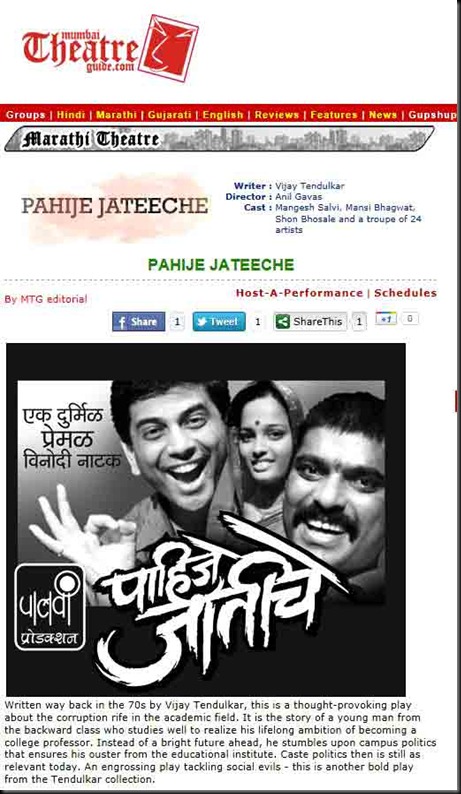
समांतर-प्रायोगिक रंगभूमीवर काल झालेली नाटकं आज मुख्य धारेतील रंगभूमीवर सादर होतात तेव्हा रंगभूमी पुढे गेल्याची खूण पटते. आशय-विषयात आणि सादरीकरणात काल जो 'प्रयोग' ठरत होता तो आज सर्वसामान्य नाट्यरसिक नीट स्वीकारताना दिसताहेत. विजय तेंडुलकरांची अशी प्रयोगशील नाटकं त्यांच्या वेगळेपणासकट व्यावसायिक रंगभूमीवर करताना आता तरी कुणाला प्रश्न पडू नयेत. याचं अगदी ताजं उदाहरण म्हणजे 'पाहिजे जातीचे' या नाटकाचे पालवी प्रॉडक्शन या संस्थेतर्फे होणारे प्रयोग. चौतीसेक वर्षांपूर्वी हे नाटक 'आविष्कार'ने सादर केलं. अरविंद देशपांडे दिग्दर्शक आणि विहंग नायक, नाना पाटेकर, सुषमा तेंडुलकर असे कलावंत प्रमुख भूमिकेत होते. नाटकाचे शंभराहून अधिक प्रयोग झाले तरी तेव्हा आणि त्यानंतर ते मुख्य धारेत कोणी सादर केलं नव्हतं. एकतर यातली पात्रसंख्या आणि नायकाच्या अखंड निवेदनातून सरकणारी कथा हे त्यावेळच्या व्यावसायिक गणितात बसले नसावेत. आज मात्र ते दिग्दर्शक अनिल गवस आणि त्यांच्या कलावंत टीमने ते आत्मविश्वासपूर्वक आणि आकर्षकपणे पेश करत एक खळाळता नाट्यानुभव आपल्यासमोर ठेवला आहे. तसं पाहिलं तर, हे काही तेंडुलकरांच्या अव्वल नाटकांपैकी नव्हे. तरी तेंडुलकरी लेखनाची वैशिष्ट्यं त्यात पुरेपूर आहेत. विशेष म्हणजे, तेंडुलकरांच्या 'सेक्स आणि व्हायलन्स' थिअरीत खूपसा दुर्लक्षित राहिलेला तेंडुलकरी विनोद यात सापडतो, जो त्यांच्या सुरुवातीच्या नाटकांमध्ये हमखास झिरपलेला असायचा. 'पाहिजे जातीचे'चा नायक महिपती बभ्रुवाहन पोरपारणेकर याच्या निवेदनातून उलगडणाऱ्या कथानकात हा विनोद अस्तरासारखा आला आहे. किंबहुना अनेक ठिकाणी मार खाल्लेल्या, संघर्ष हेच जीवनतत्त्व बनून गेलेल्या आणि नाटकातील गोष्टीतही अंतिमत: पराभूत होणाऱ्या महिपतीच्या जीवनदृष्टीचाच हा विनोद एक भाग आहे. तो साऱ्या निराशाजनक परिस्थितीकडे खट्याळपणे, मिष्किलपणे बघतो म्हणूनच तगून राहू शकतो. या वैशिष्ट्यपूर्ण विनोदाचं आव्हान नव्या प्रयोगाने फार उत्तम पेललं आहे. स्वत:ला हसत हसत व्यवस्थेने करून ठेवलेली मधल्या जातीत जन्मण्याची गोची महिपती फार नेमकेपणाने सांगून जातो.
शिक्षणाच्या नावाखाली बोगस विद्यार्थ्यांची नोंद, शिक्षकांची मागणी आणि त्यासाठी मिळणारं सरकारी अनुदान लाटणं हे प्रकार आत्ताआत्ताच वर्तमानपत्रात येऊन गेले. महिपती खेड्यात जन्मलेला, गरीब घरातला पण कष्टाने थर्ड क्लास एम. ए. झालेला तरुण काहीही करून गाव सोडायचं आणि शहरात जाऊन नोकरी करायची या वीतभर ध्येयाने पछाडलेला पण तेही साधता साधता दमछाक झालेला. तरीही चेहऱ्यावर प्रसन्नता ठेवून असलेला. प्राध्यापकाची नोकरी मिळावी म्हणून सगळीकडे अर्ज टाकून नकार घेत बसणं त्याच्या नशिबी आलंय. योगायोगाने त्याला एका खेड्यातल्या कॉलेजातून कॉल येतो, जे गुरांच्या गोठ्यातच भरतं. तिथे नोकरी लागल्यावर ती टिकवून ठेवणं हेच कसं दिव्य बनतं आणि अंतिमत: त्याची जातच त्याच्या मुळावर कशी येते, याची धमाल गोष्ट तो स्वत:च्याच तोंडाने सांगतो.
अनिल गवस यांनी वरकरणी सोपं वाटणारं पण पेलायला कठीण असलेलं हे नाटक अत्यंत नेटकेपणे आणि परिणामकारक हाताळलंय. एकीकडे महिपतीचं अखंड निवेदन आणि दुसरीकडे त्याला पूरक नाट्यप्रसंग घडवण्यासाठी केलेला समूहाचा वापर या दोन्हींचा समतोल गवस यांनी चांगला सांभाळला आहे. एखादी कॉमिक स्ट्रीप बघावी तशी काही समूह आकृतीबंधांची मालिका डोळ्यापुढून सरकते. समूहाचा गोंधळही सुनियंत्रित आहे. खूप मोठ्या लांबीचं निवेदन हे सादर करताना फसलं तर कंटाळवाणं होतं, पण गवस यांनी त्यातलं कथन रंजक कसं राहील हे पाहिलंय. प्रदीप पाटील यांच्या रंगवलेल्या फ्लॅटस्नी विविध प्रसंगांतली नेपथ्याची गरज उत्तमपणे भागवत त्यातली गतिमानता राखायलाही मदत केली आहे. नाटकातला खटकणारा भाग एकच आहे तो म्हणजे त्यातल्या नृत्यप्रधान गाण्यांचा. ही गाणी आणि नृत्यं स्वतंत्रपणे चांगली असली तरी नाटकाच्या जातकुळीशी त्यांचा मेळ जुळत नाही. पार्श्वसंगीत मात्र उत्तम आहे.
मंगेश साळवी (महिपती), शोण भोसले (बबन्या पवार) आणि मानसी भागवत (नलिनी) या तीन पात्रांना संपूर्ण नाटकात महत्त्व असलं तरी पंचवीसेक कलावंतांनी समूहातल्या छोट्या-मोठ्या भूमिका बहारदार केल्या आहेत. यातल्या काहींच्या वाट्याला छोट्या व्यक्तिरेखाही आल्या आहेत. त्या त्यांनी उत्कटपणे साकारल्या आहेत. सुनील पेंडुरकर हा दोन-तीन छोट्या भूमिका करणारा कलावंत त्याचं व्यक्तिमत्व आणि शैली यामुळे लक्षात राहतो. सर्व कलावंत नवे असले तरी समूह म्हणून ते आत्मविश्वासाने पेश होतात.
मंगेश साळवी या कलावंताचा महिपती संस्मरणीय आहे. नाटकाचा तो नायक आहे, कथानकाचा सूत्रधार आहे आणि अदृश्य नियतीच्या हातातलं कळसूत्री बाहुलंही आहे. या तीनही पातळ्यांचं भान मंगेशच्या निवेदनातील बदलत जाणाऱ्या पोतांमधून व्यक्त होतं. विनोदाची त्याला उत्तम समज आहेच पण व्यक्तिरेखेचा ठावही त्याने जाणकारीने घेतला आहे. शोणचा रांगडा बबन्या पवार हा त्याच्या सहज शैलीतल्या अदाकारीने लक्षात राहतो. त्याचा बबन्या अकृत्रिम आहे. त्याचं गडबडणं, नर्व्हस होणं, आक्रमक होणं ह्या सगळयातला गावठी मॅडनेस हा कलावंत दाखवतो. मानसी भागवतने नलिनी ठसक्यात आणि लोभस उभी केली आहे. यांच्या जोडीला आक्का, ईश्वरभाई, प्राचार्य या लहान व्यक्तिरेखाही लक्षात राहतात.
निर्मिती : पालवी प्रॉडक्शन
लेखक : विजय तेंडुलकर
दिग्दर्शक आणि प्रकाशयोजना : अनिल गवस
संगीत : आतिष कोंड्री
पार्श्वसंगीत : नंदलाल रेळे
नेपथ्य : प्रदीप पाटील
कलावंत : मंगेश साळवी, शोण भोसले, मानसी भागवत, सुनील पेंडुरकर, प्रभाकर कर्ले, गणेश घाडी, मनीष शिंदे, ज्योती बामणे, रश्मी शिंदे, राकेश पाटील, राहुल कुलकर्णी, उदय दरेकर, सुशांत काकडे, महेश निकम, क्षितीज पन्हाळे, विश्वंभर जाधव, मदन देशमुख, प्रसाद शेट्ये, तेजस भोर, प्रशांत मोहिते, कुणाल मेश्राम, मृणाल झेंडे, सुजाता पंड, प्रतीक्षा चव्हाण, धनश्री जैन, विशाल कुलथे, नीलेश शेवडे.

- जयंत पवार (सुप्रसिद्ध नाट्य समीक्षक, लेखक, पत्रकार )
Tuesday, August 30, 2011
“पाहिजे जातीचे” नाट्य-वलोकन

आताच आमच्या "पाहिजे जातीचे" या नाटकाचे
(लेखक: विजय तेंडूलकर , दिग्दर्शक : अनिल गवस) झी मराठी च्या हाउसफुल कार्यक्रमात नाट्य-वलोकन झाले मला खात्री आहे तुम्ही नकीच ते पहिले नसणार......नाही नाही ... कारण २८ ऑगस्ट ला भर पावसात सकाळी ११ वा. तुम्ही शिवाजी मंदिर दादर ला त्याच नाटकाचा प्रयोग बघत असणार! ह्म्म्मम्म्म्म धन्यवाद ! आम्हा सगळ्यांचे सुद्धा पहायचं राहीलच हो!
पण ज्यांचे पाहायचे राहिलंय त्यांनी एक नजर मारायला काय हरकत आहे!
हो आणि पुढच्या प्रयोगाला नक्की भेटूच बरंका ! प्रयोग ९, १०, किंवा ११ सप्टेंबर २०११ ला लागण्याची शक्यता आहे. वर्तमान पत्रातल्या जाहिरातींवर लक्ष ठेऊन राहा !
Friday, July 15, 2011
We Should “make OURSELF Anti Bomb-Blast Product”
आताच झालेल्या मुंबई बॉम्बस्फोटात बऱ्याच निष्पाप नागरिकांचे प्राण गेले.
अतिशय वाईट, दर्पोक्तीयुक्त, भ्याड, सुनियोजित Anti – Social किंवा समाज विघातक असा हा “संदेश” होता. बऱ्याच जणांचे असे मत आहे कि हे थांबू शकत नाही, किंवा यावर अंकुश ठेऊ शकता नाही.
पण मला काही गोष्टी वर दृढ विश्वास आहे.

उर्जेचे काही नियम इथे लाऊन बघू शकतो
- उर्जा कधीही बनवता येत नाही. [energy can not be created (produced)]
- तशी ती स्वता:हून संपवता येत नाही. [energy can not be destroyed by itself]
- उर्जा कधीच संपत नाही. [energy never dies]
- उर्जा एका गोष्टींतून दुसऱ्या गोष्टीत परावर्तित होऊ शकते'. It can only be transformed
Energy is the capacity of a physical system to perform work. Energy exists in several forms such as heat, kinetic or mechanical energy, light, potential energy, electrical, or other forms.
According to the law of conservation of energy, the total energy of a system remains constant, though energy may transform into another form.
Any form of energy may be transformed into another form. all types of potential energy are converted into kinetic energy when the objects are given freedom to move to different position
In all such energy transformation processes, the total energy remains the same, and a transfer of energy from one system to another, results in a loss to compensate for any gain. This principle, the conservation of energy, was first postulated in the early 19th century, and applies to any isolated system. According to Noether's theorem, the conservation of energy is a consequence of the fact that the laws of physics do not change over time.
Although the total energy of a system does not change with time, its value may depend on the frame of reference.
इथे उर्जा म्हणून सगळ्या बाजुंनी (सामाजिक) विचार केला तर लक्षात येईल कि, positive = negative energy असू शकते, अर्थात त्या एकमेकांना म्हणजे वेळोवेळी वाईट प्रव्वृतिं चांगल्या प्रव्वृतिंनां Balance करीत असतात आणि तसेच उलटपक्षी चांगल्या प्रव्वृतिं वाईट प्रव्वृतिं समतोल करीत असतात
i.e. Energy is subject to a strict global conservation law; that is, whenever one measures (or calculates) the total energy of a system of particles (here take as people) whose interactions do not depend explicitly on time, it is found that the total energy of the system always remains constant.
आणि असा एकत्र येऊन तो तो समाज बनत असतो. अनेक समाजांचा एक देश असू शकतो. चांगल्या समाज हितांचा उपयोग देश उन्नतीसाठीच होतो पर्यायाने आपल्या वैयक्तिक विकास आणि उन्नती साठी होतो. स्वता:वर मनापासून प्रेम करणारा इतरांवर प्रेम करू शकतो, आणि समाजानी प्रेम केलेली व्यक्ती अमर असते. कुठलेही बॉम्ब फोडून ती अमर नसते.
काही नासक्या आंब्यान मुळे अख्खी पेटी खराब होत असेल तर ते मुळापासून हुडकून काढून बाजूला काढलेलेच बरे! ते खायला जरी बेकार असले तरी त्यांना जमिनीत कुसवून (योग्य ती क्षिक्षा करून) संस्काराच्या मुळांवर उदाहरण म्हणून घातले तर येणारी पिढी त्यांना खत समजून सकारात्मक प्रगल्भ होईल.
आणि म्हणूनच मला असे वाटते कि शाळेपासूनच स्वांतत्र्य आणि त्याच्या मुल्यान बाबत तसेच त्यावरील हल्यान बाबत सर्व अंगाने (सर्व विषयांमध्ये ) अभ्यास अंतर्भूत केला पाहिजे. अगदी पदवी नंतर मिलेट्री सेवा आवश्यक करावी. त्यामुळे मोठेपणी वाईट वृत्तींची सलगी त्या वेळच्या त्यांच्या संस्कारक्षम, पिळदार बाल्य मना (Innocence ) करवी तसे करू देणार नाही.
जगण्या मरण्याच्या या यंत्रणेत (System) जगण्याबाद्द्लचा सकारात्मक स्वार्थीपणा माणूस कधीच विसरणार नाही. जरी मारण्याच्या ह्या भितीने जरासा विस्कटेल, परावर्तित होईल. पण संपणार नाही. फक्त गरज आहे ती त्याच्यातल्या मुलभूत संवेदनशील मन जागरूक आणि भक्कम करायची , जेणे करून हि सहनशीलतेची “स्थितीज उर्जा” [Potential Energy] झालेल्या उण्या नुक्सानासकट अनेक पटीनी गुणित होऊन “गतीज उर्जेत” [Kinetic energy] परावर्तित व्हायला हवि.
Distinction between
energy (जनशक्ती किंवा समाजविघातकता)
and power (Politics)
Although in everyday usage the terms energy and power are essentially synonyms, scientists and engineers distinguish between them. In its technical sense, power is not at all the same as energy, but is the rate at which energy is converted (or, equivalently, at which work is performed). Thus a hydroelectric plant, by allowing the water above the dam to pass through turbines, converts
the water's potential energy into kinetic energy and ultimately into electric energy, whereas the
amount of electric energy that is generated per unit of time is the electric power generated.
By above in a different sense terrorism is a grand child of “THE” Politics today.
So I demand …We Should “make OURSELF Anti Bomb-Blast Product”
दहशतवादा वर उपाय शोधा तशी प्रयोगशीलता तुमच्या रोजच्या व्यवहारात आणा.
इंजिनीयर, ब्लोगर्स, वेब डेव्लोपर, डॉक्टर्स, सच्चे नेते, कवी, लेखक, लहान मोठे उदोजक, कलाकार, सामान्य कोणीही माणूस Anti-Terrorism products बनवा आणि त्यांचा सगळीकडे प्रसार करा.

सपोर्ट करा मला ! तुम्ही काय करू शकता ? या एकत्र येऊन त्यांच्याच चिंधड्या करू!
सुरुवात या लिंकने हि होऊ शकते !
Click on Anti Bomb-Blast Products

Give IDEAS
1. ANTI Terror action protocols for general public.
2. Anti Terror infrastructure in e-governance
3. Anti terror medical Squad.
4. Anti terror Military, medical, engineering products.
5. Anti terror city sensor based gadgets for surveillance and preventions.
6. Anti terror FUND from many countries & it’s distribution in proper hand and perfect use of the system.
list is VERY BIG …Just start it

मंगेश साळवी

Thursday, July 14, 2011
Does Indian animation films need a Novel based Characters than GOD’s Stories?
DID YOU see Kung Fu Panda 2 and wonder why the best animation we can manage is an unintended horror show in 3D called Bal Ganesh? How is it that in a cultural legacy so vibrant with children’s tales, the only stories we have to tell through animation involve rigid gods without a sense of fun?
Indian animation, which at the start of this decade was predicted to be the next big thing, is facing a crisis. But just as the hype begins to turn sour for Indian animators, comes an interesting experiment in the form of an irascible monkey and a worldly parrot with a penchant for scotch whisky.

To read media reporting on the Indian animation industry is to be buoyed with a sense of rainbow-hued goodtidings, much like the sunny commentary surrounding the country’s GDP. It is reported, for example, that by 2012, the industry is headed for a turnover of $1 billion, comprising a 1 percent share in the global animation industry. Much of it to give way to a home-grown army of animators exercising their (now) matured talent on Indian characters, telling Indian stories to Indian children in an Indian way. The trouble with that narrative is that it’s a decade old and hasn’t come true. Animation is an intense mix of high creativity and hard labour. Behind every frame and every detail is an army of specialists who model, structure, colour, texture, animate, design, imagine and dialogue the characters and the world they inhabit, literally, over years. Given the sheer quantum of labour, it’s no accident that this industry was among the first to open itself to outsourcing.
The expected evolution from outsourced labour work for, say, a Walt Disney feature, to the making of a homegrown story, indigenously imagined and told, has not happened.
Neha Shah Pastakhia, 32, has been in the animation industry since 2002. She says, “It’s a factory floor in India with a supervisor foreman who demands how many seconds of finished labour I am going to give him today. There is zero creativity. Forget about original work. Anyone who has tried it has closed down. There is a saturation point to doing someone else’s work and I know many in the field who have been working for more than 10 years and are just waiting to get out.”
The ire lies in the paradoxical nature of the work. Animation, as opposed to other kinds of outsourcing, is an aesthetic art and even in its drudgery requires craft and skill — in fact, the ownership and investment in the creative aspects often fuels the drive to work on all the less creative, but equally important laborious details. So to understand Pastakhia’s position, imagine you are trained as a painter and see yourself in the same profession as Pablo Picasso, but then find that the only job you are allowed to do is to fill in colours on numbered squares belonging to someone else.
Bollywood doesn’t see business sense in animation. The most it does is halve the duration, slash budgets, discount quality and make it mythological
What’s worse is that even the coloured squares are now diminishing. In the aftermath of the economic crisis, animation outsourcing business is not what it once was. The projects have become fewer, the market has become aggressive and India is far behind its competitors.
RAM MOHAN, chairman of Graphite Multimedia and an industry veteran of 54 years, says, “Even in the outsourcing market, we are nowhere close to the competition. Korea and Singapore produce 10-15 seconds of work per day per artist. China produces 13 seconds. The average Indian animator’s output on a high quality work is 0.5 seconds per day.”
This ineptitude is in large part due to training. Says Mohan, “It’s a mercenary approach. Take money and hand out a certificate. Often the guy who’s passed out the year before is your teacher this year. Young people are misguided by the hype surrounding animation. They have been given the impression that all you need is a 6-8 month course in software.”
The training racket churns out an average of above 10,000 animators each year. On an average, the institutes charge up to Rs 3 lakh. In a market environment, where the lowest bids that get an outsourcing project are getting lower still, salaries have fallen (the starting salary of an animator today is around Rs 7,000 as opposed to Rs 11,000 in the early 2000s). Meanwhile, the mid-level animators are losing their jobs to newly minted ones because they will work for less. The result is a stasis four to five years after committing to the profession, living on contracts with no guarantee that others will follow.
Sekhar Mukherjee, head of animation, National Institute of Design, summarises, “The picture is grim. This is a turbulent time for the industry. The hope was for a contentheavy culture. We are once again seeing mythological releases. There is very little original work.”
The way forward for the Indian animation industry is to graduate from a labour camp to original creations. That seems difficult today because Bollywood refuses to see the business sense in backing an animation film that will take three years in the making, cost money, require talent and then fizzle at the box office. The most it’s willing to do is halve the time taken, quarter the budget, discount quality and make it mythological under an ‘also educational’ logic.
Hence the buzz around India’s first indigenously made stereoscopic (you will need glasses) 3D animation feature — Delhi Safari. Slated to be released in India soon, Delhi Safari begins at Mumbai’s Borivili National Park, where a special day turns tragic when human encroachment leads to the death of Sultan — the leader of the leopards. Bajrangi, the militant monkey, is keen on waging war on the humans, but Bagga — a bear who is a pacifist and Bajrangi’s anger management therapist, prevails on the animals to give diplomacy a try. With the aid of the talking parrot Alex — a south Mumbai hedonist — the animals begin their adventure from Mumbai to Delhi, to meet the leader of the humans who sits in a place called Parliament. Made by a small Pune-based animation studio called Krayon Pictures, the film is directed by Nikhil Advani and was four years in the making. Its cost, as a source reveals, is Rs 27 crore. The dubbed English version that’s been made for international release has songs by Vanessa Williams and features Seinfeld’s Jason Alexander.
Given the future facing Indian animation, it would be interesting to see how Delhi Safari, with its original characters and novel script, fares at the box office. Indian animation needs the animals to do well.
Thursday, March 24, 2011
Popatpanchi play review
Direction : Shafat Khan
Writer : Shafat Khan
Cast : Mangesh Salvi, Parag Bedekar, Siddhesh Shelar, Rasika Agashe
By -----> Deepa Ranade
Barring the folk theatre of Tamasha, Marathi theatre by and large has steered clear of lascivious themes. Taking immense pride in its pristine themes with intellectual thrust, Marathi plays are boastful of maintaining "high standards." But Shafat Khan's POPATPANCHI throws the rule book in the bin and re-invents the syntax of a modern Marathi comedy.

POPATPANCHI takes off with an item song. What with bar girls swinging to 'Munni badnam huee...' and their inebriated fans dancing along, it is pandemonium on stage and before you recover - the narrator swaggers in and cautions you to expect the unexpected. He warns you about the disjointed series of events that are about to unfurl before you. Sure enough, before you realize, you are sucked into the vortex of the bizarre tale of a don who has just married his lady love, Maina (Rasika Agashe) who used to be a bar dancer. Now on the run, he is forced to leave his bride alone at home.
The don is reluctant to let attractive Maina be left amongst his men and so he entrusts his spiritual Guru with her responsibility. But since Maina is contemptuous about god men and divine intervention of any sort, Guru has to appear before her in the guise of a story teller - Popat (Mangesh Salvi). Inspired by Shukbahattari, a time-honored folk novel, the parrot is the storyteller here who keeps Maina amused with naughty yet thought-provoking tales. Almost like Princess Scheherazade of Arabian Nights. But the roles are reversed here and Maina is not easy to please.
She sets some tough conditions before Popat that his stories "must be modern but not moralistic, amusing but not with a predictable 'they lived happily ever after.' They must have an 'easy and yet disjointed format.' Fearing for his life, Guru turned Popat starts weaving tales to keep Maina engaged.
He begins with the story of an honest cop who is in charge of the departmental sniffer bitch and is now facing an official enquiry for letting the bitch get impregnated! His wife thinks of sex unconsciously all the time and is far from happy with her physical appearance. She is keen to have her 'twin assets' enhanced with surgical intervention from Dr. Pyramidwala (indeed, pun intended). On the other hand the Police Commissioner heading the nefarious enquiry against the honest cop has a change of heart and decides to have a sex change operation from none other than Dr. Pyramidwala.
Outside of the story session, Maina is increasingly drawn to Popat but he has been neutered by the don in case that he gets tempted to bed Maina. So our clever Popat also approaches Dr. Pyramidwala to affix him the requisite, synthetic organ. This is where the imaginary realm overlaps the real life and the stories get entangled in a baffling yet thoroughly amusing manner. Most of the stories in the play are funny and witty on the surface but incisive and thought provoking at a deeper level. The tales are titillating as well as evocative but never crass or crude. And that is where this mature comedy scores.
The writer mocks the term "vulgarity" by using it repeatedly out of context, thereby trivializing its impact. But he gets bowed down by the onus of his innovativeness by unnecessarily including the episode of the sex change of the police commissioner and then taking it as far as getting him in the family way. This is the sole aberration in this otherwise free flowing farce.
Since the script is so multi-threaded, it required the writer to double up as the director to execute ideas in motion. Shafat Khan handles both the portfolios adeptly. As for the performers, Popat - Guru- Narrator is played effortlessly by young Mangesh Salvi, although Rasika Agashe is not exactly the bombshell. But yet she does a fair job of conveying Maina's sassiness. A special mention to Purnanad Wandhekar's spontaneous acts as the drunken Tirlya Sawant havaldar and ward boy Lingappa. Ajay Pujare's functional and multi-purpose set works well in this multi-track narrative. Rahul Ranade's music score adds to the fun element.
POPATPANCHI combines the western technique of Farce with the folk tradition of Tamasha, and the outcome is one joyride.
*Deepa Ranade is a film and theatre reviewer. She has been an entertainment journalist for over fifteen years.
Writer : Shafat Khan
Cast : Mangesh Salvi, Parag Bedekar, Siddhesh Shelar, Rasika Agashe
Popatpanchi play review
Web linkBy -----> Deepa Ranade
Barring the folk theatre of Tamasha, Marathi theatre by and large has steered clear of lascivious themes. Taking immense pride in its pristine themes with intellectual thrust, Marathi plays are boastful of maintaining "high standards." But Shafat Khan's POPATPANCHI throws the rule book in the bin and re-invents the syntax of a modern Marathi comedy.
POPATPANCHI takes off with an item song. What with bar girls swinging to 'Munni badnam huee...' and their inebriated fans dancing along, it is pandemonium on stage and before you recover - the narrator swaggers in and cautions you to expect the unexpected. He warns you about the disjointed series of events that are about to unfurl before you. Sure enough, before you realize, you are sucked into the vortex of the bizarre tale of a don who has just married his lady love, Maina (Rasika Agashe) who used to be a bar dancer. Now on the run, he is forced to leave his bride alone at home.
The don is reluctant to let attractive Maina be left amongst his men and so he entrusts his spiritual Guru with her responsibility. But since Maina is contemptuous about god men and divine intervention of any sort, Guru has to appear before her in the guise of a story teller - Popat (Mangesh Salvi). Inspired by Shukbahattari, a time-honored folk novel, the parrot is the storyteller here who keeps Maina amused with naughty yet thought-provoking tales. Almost like Princess Scheherazade of Arabian Nights. But the roles are reversed here and Maina is not easy to please.
She sets some tough conditions before Popat that his stories "must be modern but not moralistic, amusing but not with a predictable 'they lived happily ever after.' They must have an 'easy and yet disjointed format.' Fearing for his life, Guru turned Popat starts weaving tales to keep Maina engaged.
He begins with the story of an honest cop who is in charge of the departmental sniffer bitch and is now facing an official enquiry for letting the bitch get impregnated! His wife thinks of sex unconsciously all the time and is far from happy with her physical appearance. She is keen to have her 'twin assets' enhanced with surgical intervention from Dr. Pyramidwala (indeed, pun intended). On the other hand the Police Commissioner heading the nefarious enquiry against the honest cop has a change of heart and decides to have a sex change operation from none other than Dr. Pyramidwala.
Outside of the story session, Maina is increasingly drawn to Popat but he has been neutered by the don in case that he gets tempted to bed Maina. So our clever Popat also approaches Dr. Pyramidwala to affix him the requisite, synthetic organ. This is where the imaginary realm overlaps the real life and the stories get entangled in a baffling yet thoroughly amusing manner. Most of the stories in the play are funny and witty on the surface but incisive and thought provoking at a deeper level. The tales are titillating as well as evocative but never crass or crude. And that is where this mature comedy scores.
The writer mocks the term "vulgarity" by using it repeatedly out of context, thereby trivializing its impact. But he gets bowed down by the onus of his innovativeness by unnecessarily including the episode of the sex change of the police commissioner and then taking it as far as getting him in the family way. This is the sole aberration in this otherwise free flowing farce.
Since the script is so multi-threaded, it required the writer to double up as the director to execute ideas in motion. Shafat Khan handles both the portfolios adeptly. As for the performers, Popat - Guru- Narrator is played effortlessly by young Mangesh Salvi, although Rasika Agashe is not exactly the bombshell. But yet she does a fair job of conveying Maina's sassiness. A special mention to Purnanad Wandhekar's spontaneous acts as the drunken Tirlya Sawant havaldar and ward boy Lingappa. Ajay Pujare's functional and multi-purpose set works well in this multi-track narrative. Rahul Ranade's music score adds to the fun element.
POPATPANCHI combines the western technique of Farce with the folk tradition of Tamasha, and the outcome is one joyride.
*Deepa Ranade is a film and theatre reviewer. She has been an entertainment journalist for over fifteen years.
Wednesday, January 19, 2011
झिंग चेsssक झिंग
रेश्मी आठवणींच्या सुवर्णमूद्रा,
मरणार्याच्या मढ्यावर ’स्वाहा:’ म्हणून कधि म्हणू नये
हा मेला तो गेला ह्यात कधि अडकूनहि पडू नये,
पण…
हा मेला तो गेला ह्यात कधि अडकूनहि पडू नये,
पण…
जगणारयाचि फिलोसोफि, बेस्ट सेलर म्ह्णून
त्याच्याच तेराव्याला विकू नये.
म्हट्ले तर शब्द, म्हटले तर भावना, म्हट्ले तर शब्द, म्हटले तर भावना,
गरजेला नाहि सापडले हे “जोडपे” तर, ’शंका’सूराच्या तांडवात पायदळि तरी तूड्वू नये.
म्हट्ले तर शब्द, म्हटले तर भावना, म्हट्ले तर शब्द, म्हटले तर भावना,
गरजेला नाहि सापडले हे “जोडपे” तर, ’शंका’सूराच्या तांडवात पायदळि तरी तूड्वू नये.
आणि म्हणून…. झोपेच्या आधि जड डोके कधि असू नये,
उठल्यावर मात्र “भूतकाळा”च्या वर्तमान पत्रावर शब्दच काहि सुचू नयेत.
हल्लि म्हणे धमन्यांतुन धाऊन उसळत,
डोक्यात ’तरंगते बेट’ गाठणारी ’ती’ सुन्नच असते.
उठल्यावर मात्र “भूतकाळा”च्या वर्तमान पत्रावर शब्दच काहि सुचू नयेत.
हल्लि म्हणे धमन्यांतुन धाऊन उसळत,
डोक्यात ’तरंगते बेट’ गाठणारी ’ती’ सुन्नच असते.
मर्दूमकिच्या काठाला शरिराने बांधुन हलकेच हेलकावे घेणारी,
उथळ रक्तातली, नितळ ’ती’ आज सकाळी
उतारयाचा पेगहि प्यावा लागला नाहि म्ह्णून,
कुठल्यातरी मोरीचा कोपरा धुवत बसलेली असते. आणि म्हणून….
झोपेच्या आधि जड डोके कधि असू नये,
उठल्यावर मात्र “भूतकाळा”च्या वर्तमान पत्रावर शब्दच काहि सुचू नयेत.
तुझ्या ह्या आकाशवाणिने बघतो आता,
खरखरणा-या माझ्या रेडिओवर शांत झोपेचे स्टेशन लागते का ते!
उठल्यावर मात्र “भूतकाळा”च्या वर्तमान पत्रावर शब्दच काहि सुचू नयेत.
तुझ्या ह्या आकाशवाणिने बघतो आता,
खरखरणा-या माझ्या रेडिओवर शांत झोपेचे स्टेशन लागते का ते!
जगण्याच्या या कमर्शियल ब्रेक वर,
सुखि: माणसाच्या गोष्टित सुखा:न्तिकेचा पाळणा जोजवते का ते!
आणि म्हणून…. झोपेच्या आधि जड डोके कधि असू नये,
उठल्यावर मात्र “भूतकाळा”च्या वर्तमान पत्रावर शब्दच काहि सुचू नयेत.
मंगेश साळवी.
Thursday, December 30, 2010
सण साले स्वत: वाइन्डे असतात
by Mangya Sal on Thursday, December 30, 2010 at 3:58am
सण साले स्वत: वाइन्डे असतात,
येणार येणार म्ह्णून खूप वाट बघायला लावतात,
आले कि साले चार दिवसात प्रकाश करुन धुम पळून जातात,
वाटे कडे त्यांच्या डोळे लावले... तर, वेडा आहेस का?,
तूळशीच्या लग्नापर्यंत आम्ही रेंगाळणार म्हणतात.
सण साले स्वत: वाइन्डे असतात
दिव्या खालचा अंधार, भूईमूगाचे सत्व, नाजूक कापसांची पिळवटलेली आतडी
रस्व दिर्घ म्हणीत ह्याच मातिच्या ओंजळीत,
स्वता: जळत डोळ्यांना मात्र मिणमिणतांना दिसतात
स्वता: जळत डोळ्यांना मात्र मिणमिणतांना दिसतात
उष:काल होण्या आधिचा अंधार मात्र... दिवस म्ह्णून साजरा करा!
असे सूगंधी-आशेचे उट्णे पण लावतात.
असे सूगंधी-आशेचे उट्णे पण लावतात.
सण साले स्वत: वाइन्डे असतात येणार येणार म्ह्णून खूप वाट बघायला लावतात,
आले कि साले चार दिवसात प्रकाश करुन धुम पळून जातात
पूढ्च्या खेपे पर्यंत दरवाज्यात लोम्बत फासावर लटकवलेले चुरचूरणारे वार्धक्याचे पान
त्याच्याच हिरव्या-गार केसरी-पिवळ्या बालपणानं,
नक्ळत डोक्याला पावित्र स्पर्शून गेले म्ह्णून
नक्ळत डोक्याला पावित्र स्पर्शून गेले म्ह्णून
सनईचे तेच ते रडू करायला लावतात बेभान...
सण साले स्वत: वाइन्डे असतात, येणार येणार म्ह्णून खूप वाट बघायला लावतात,
आले कि साले चार दिवसात प्रकाश करुन धुम पळून जातात
साले येतात तर येतात, अंधारात खूप रेंगाळत खोलवर रूतून राहतात,
बंद डोळ्याबाहेरचा प्रकाश पाहाटेच्या स्वप्नांची राखरांगोळी करून जातात,
एका चिमटितंन निसटलेल्या वळ्णा-वळ्णा वरच्या अनेक रंगिबेरंगी क्षणांची रांगोळि
एका चिमटितंन निसटलेल्या वळ्णा-वळ्णा वरच्या अनेक रंगिबेरंगी क्षणांची रांगोळि
कुठल्यातरी लहरी वा-याच्या झूळकेला,
कृष्ण-लिलांचा वास्तादेऊन,
कृष्ण-लिलांचा वास्तादेऊन,
बिघडवलेल्या त्याच रांगोळीला रौद्र समूद्राच्य़ा लाटांची
सळसळती किनार दाखऊन जातात
सळसळती किनार दाखऊन जातात
सण साले स्वत: वाइन्डे असतात
येणार येणार म्ह्णून खूप वाट बघायला लावतात,
आले कि साले चार दिवसात प्रकाश करुन धुम पळून जातात
स्वत:साले साजरे होतात,
अंतापर्यंत साले हाती धूपाटणं देऊन, दिव्याच्या सत्वाची भिक मागायला लावतात
सण साले स्वत: वाइन्डे असतात... सण साले स्वत: वाइन्डे असतात
मंगेश साळवी
चूंबक सूई (अर्थात आज तू म्हणशिल ती पूर्व !)
आकृष्ट प्रेमाच्या जिवावर तिही म्हणे खलबते फिरवते,
भल्या भल्या दिप-स्तंभाना निशब्द गर-गरवत स्तंभित करते
उद्याची चिंता मला मान्य नाहि म्ह्णते,
पाक्षिक न होता पून्हा "आज तू म्हणशिल ती पूर्व!" म्ह्णते,
प्रवास घडवत, अथांग खारवटलेल्या अश्रूत,
उसळी मारुन नागमोडी वळण घेत तरीहि जिवंत,
आजहि तुझ्याच बळावर, तिच ती श्रद्धा रापत सबका मालिक एक म्हणत
पून्हा आज तू म्हणशिल ती पूर्व! म्हणते,
हिमनगाचे मानी नाक चूकवायला तिलाहि तो अदभूत त्रिकोण लागतो,
तेंव्हा मात्र तिचा "तो" स्वप्नाळू मळभ अलगत आपला रंग बदलतो,
झोडपणारा पाऊस आतून एकदम शूष्क करून जातो,
"दिशांचा तिर" हि मग सतत ऐकमेकांच्या पाठिवर "मी" म्हणतो
तेव्हांहि ती लक्ष ठेऊन असते क्षितिज रेषेतल्या म्रुगजळावर
चुकून ढग, मळभ बाजूला सारुन दिसतोय का एखादा सोनेरी "पूर्व" सूर्योदयावर,
एका टिचकी सरशी गिरकी घेत पून्हा कालच्या वादळाची पटकन
सारवासारव करायला अनं पून्हा तेच ते म्हणायला तयार...
आज तु म्हणशिल ती पूर्व !
आज तु म्हणशिल ती पूर्व !
मंगेश साळवी.
Sunday, December 19, 2010

Monday, December 13, 2010
'पोपटपंची' या नाटकाचा शुभारंभाचा प्रयोग ४ डिसेंबरला.
| ३० नोव्हेंबर © मराठीमुव्हीवर्ल्ड 'मॅजिक वॉल' या बॅनरखाली निर्माते विक्रम वाटवे आणि प्रदीप मुळ्ये यांनी पोपटपंछी' या आपल्या नाटकाचा पहिला शो ४ डिसेंबर २०१० रोजी आयोजित केला आहे. या नाटकात प्रसिद्ध कलाकार न दिसता नविन चेहरे दिसणार असल्याचं नाटकाचे दिग्दर्शक शफाहत खान यांनी प्रभादेवी येथे झालेल्या पत्रकार परिषदेत सांगितलं.
|


Tuesday, October 5, 2010
Company Names History
Hewlett-Packard

Bill Hewlett and Dave Packard tossed a coin to decide whether the company they founded would be called Hewlett-Packard or Packard-Hewlett.

Yahoo!

The word was invented by Jonathan Swift and used in his book Gulliver's Travels. It represents a person who is repulsive in appearance and action and is barely human. Yahoo! founders Jerry Yang and David Filo selected the name because they considered themselves yahoos.

Xerox

The Greek root "xer" means dry. The inventor, Chestor Carlson, named his product Xerox as it was dry copying, markedly different from the then prevailing wet copying.

Sun Microsystems

Founded by four Stanford University buddies, Sun is the acronym for Stanford University Network.

Sony

From the Latin word 'sonus' meaning sound, and 'sonny' a slang used by Americans to refer to a bright youngster.

SAP

"Systems, Applications, Products in Data Processing", formed by four ex-IBM employees who used to work in the 'Systems/Applications/Projects' group of IBM.

Red Hat

Company founder Marc Ewing was given the Cornell lacrosse team cap (with red and white stripes) while at college by his grandfather. He lost it and had to search for it desperately. The manual of the beta version of Red Hat Linux had an appeal to readers to return his Red Hat if found by anyone!

Oracle

Larry Ellison and Bob Oats were working on a consulting project for the Central Intelligence Agency (CIA). The code name for the project was called Oracle (the CIA saw this as the system to give answers to all questions or something such).

Motorola

Founder Paul Galvin came up with this name when his company started manufacturing radios for cars. The popular radio company at the time was called Victrola.

Microsoft

It was coined by Bill Gates to represent the company that was devoted to MICROcomputer SOFTware. Originally christened Micro-Soft, the '-' was removed later on.

Lotus

Mitch Kapor got the name for his company from the lotus position or 'padmasana.' Kapor used to be a teacher of Transcendental Meditation of Maharishi Mahesh Yogi.

Intel

Bob Noyce and Gordon Moore wanted to name their new company 'Moore Noyce' but that was already trademarked by a hotel chain, so they had to settle for an acronym of INTegrated ELectronics.

Hotmail

Founder Jack Smith got the idea of accessing email via the web from a computer anywhere in the world. When Sabeer Bhatia came up with the business plan for the mail service, he tried all kinds of names ending in 'mail' and finally settled for Hotmail as it included the letters "html" - the programming language used to write web pages. It was initially referred to as HoTMaiL with selective upper casings.


The name started as a jockey boast about the amount of information the search-engine would be able to search. It was originally named 'Googol', a word for the number represented by 1 followed by 100 zeros. After founders - Stanford graduate students Sergey Brin and Larry Page presented their project to an angel investor, they received a cheque made out to 'Google

Cisco

The name is not an acronym but an abbreviation of San Francisco. The company's logo reflects its San Francisco name heritage. It represents a stylized Golden Gate Bridge.

Apple Computers


Favourite fruit of founder Steve Jobs. He was three months late in filing a name for the business, and he threatened to call his company Apple Computers if the other colleagues didn't suggest a better name by 5 o'clock.
Apache

It got its name because its founders got started by applying patches to code written for NCSA's httpd daemon. The result was 'A PAtCHy' server - thus, the name Apache.
Adobe

The name came from the river Adobe Creek that ran behind the house of founder John Warnock.
Sunday, October 3, 2010
Ordinary girl…from the first sight (7 pics)
27 Feb 2009 / 330641 views
Let me introduce you Tica.
She is an absolutely normal girl, BUT.
There is one difference which is not that obvious at first.
To see it, you should look closely…

The thing is that she’s not real. She was drawn by Dru Blair


Moreover, she even appeared on the cover of a magazine 
But the funniest thing, her photograph was photoshopped before being published )

Thursday, June 10, 2010

Wednesday, March 3, 2010
Thinking about AVATAR-2
Avatar 2, 03 Mar 2010 14:02:15 GMT
'Avatar' Producer Says 'Battle Angel Alita' Has A New Name, Will Follow 'Avatar 2'
'Avatar' Producer Says 'Battle Angel Alita' Has A New Name, Will Follow 'Avatar 2'
Remember the good old days of 2005? MySpace was taking over the Internet, Mel Gibson was unleashing R-rated tirades that weren’t in any film script —
and some long-forgotten hermit named James Cameron was making public appearances, claiming he had two boundary-breaking projects on the horizon.
Well, as it turns out, he was right — and choosing “Avatar” as the first of the two films to make seems pretty damn brilliant in retrospect. But what about the other movie?
“'Avatar' was something Jim had written before, but we were about to embark on a film called ‘Battle Angel: Alita,’ and then we looked at ourselves and
said ‘Wait a second, ‘Avatar’ is something that Jim always referred to as his magnum opus, and we can do it now,’” remembered the filmmaker’s producing partner,
Jon Landau. “But [‘Battle Angel’] is something that Jim is very, very passionate about. It was actually »
- Larry Carroll
Friday, July 10, 2009

Subscribe to:
Posts (Atom)